

Last Updated on August 11, 2020 by Laura Turner
The function of Twitter is evolving. Since its launch in 2006, Twitter has been recognized as a one-stop-shop for the latest news, pop culture happenings, and now, viral Tik Tok videos. Many users who practice medicine capture a wide audience from their personal content. However, beneath the amusement and leisure Twitter has become a prime location for medical students looking to build a professional network, engage in advocacy, and create academic collaboration.
Some of our greatest educators and mentors can easily be accessed on Twitter. Leaders, such as the deans of medical schools and presidents of national medical organizations, can be followed. Students are reaching beyond classroom discussions to speak against social injustices and voicing concerns on current events to a global audience. The medical community on Twitter can meet and collaborate on manuscripts and projects, such as the authors of this article who recently met on Twitter.
Twitter has a special culture structured around messages that are 280-characters or less. These curated messages provide snapshots of thoughts and opinions, for instance. Within a few moments, one might be inspired or informed by thought leaders in the medical field. We’ve seen movements, such as #GetMePPE, started by a single tweet. These short messages can lead to change that medical students are welcome to lead or join.
One strategy of engagement is to tweet your own, original content. Twitter, however, offers a variety of ways to engage with others. Retweets, also known as RTs, allows you to quickly share someone else’s posts to your Twitter followers. RTs also allow you to pass information on to others while providing the option to add your own insights before reposting. Direct Messages (DM) allow Tweeters to engage privately with others. Perhaps there is a resident whose profile resonates with your mission, or a physician with an inspiring career path. You can send them a brief DM where you introduce yourself and setup a time to chat. Lastly, if you find yourself needing more than 280-characters to express your viewpoint, Twitter threads, which are a series of connected Tweets on the same topic, allow you to further elaborate on a topic and provide additional context for your followers.
Luckily, Twitter is a community without geographical boundaries. With the COVID-19 pandemic, classes are virtual, graduations are cancelled, rotations are postponed, and many students are feeling isolated. During this time of change, Twitter has matured into an incredible resource for medical students to connect with their peers, educators, and mentors, advocate for social, professional, and political issues, and find avenues to collaborate on projects.
Below are strategies that may help launch or augment a student’s experience on Twitter:
Networking
- Redefine mentorship: With over 330 million monthly Twitter users and over 500 million tweets per day, Twitter remains an untapped resource for mentorship within the field of medicine. Twitter provides a category of mentorship that may begin by reading the thoughts and reflections of influential strangers and colleagues. However, beyond that starting point, the opportunities are endless. Mentorship does not have to exist in an office-based format. It doesn’t have to be synchronous, occurring in real-time. It also doesn’t have to be longitudinal. It can be directed to groups of strangers.
- Find Good People: Recognize that the most valuable currency on Twitter are the people and the personal interactions that form. Each user typically features a short descriptor or pinned tweet at the top of a profile. These snapshots can pique your interest and facilitate a quick screening of the user’s mission or brand. Scrolling through Tweets or ReTweets can reveal further topics that interest the user.
- Create a Snowball: Soon after you find a few influential people to follow, search to see who they follow as well. This creates a web of connections and allows you to quickly scale opportunities for potential engagement.
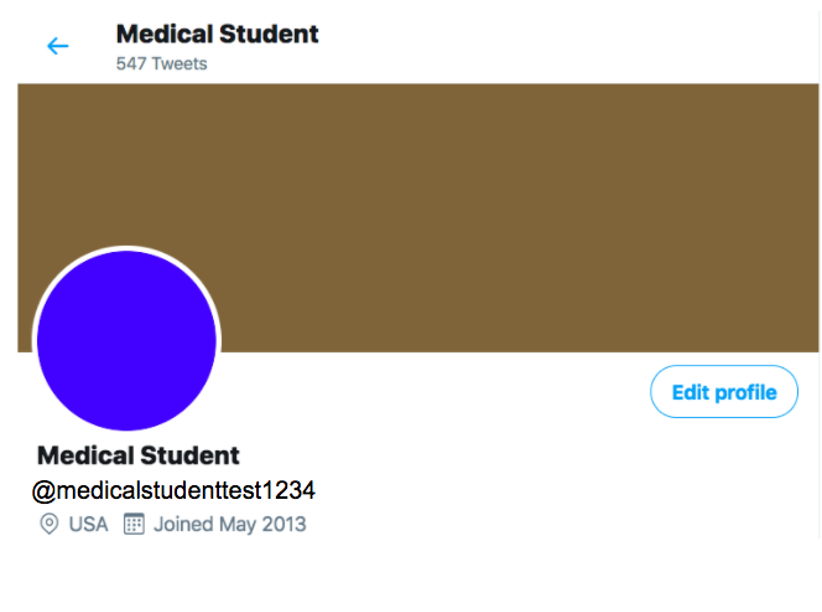
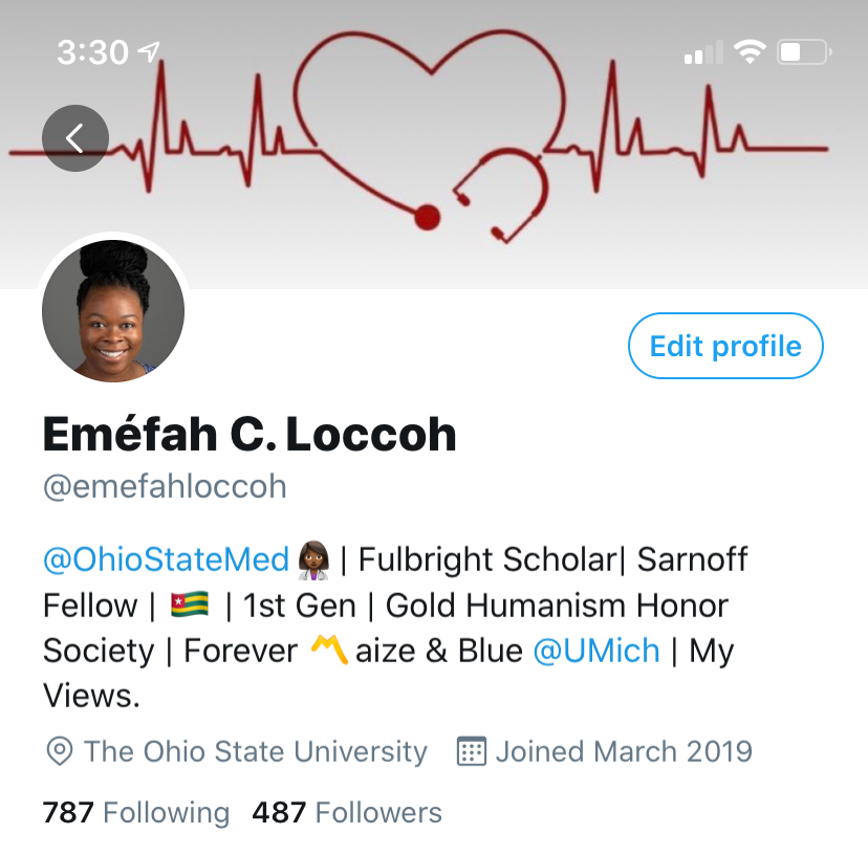
- Find your Comfort Level: You are at liberty to conceal or reveal your personal and professional identity. Figure 1 demonstrates an example of a medical student Twitter profile with a pattern of personal and professional information concealed. Figure 2 demonstrates an example of a medical student Twitter profile with a typical pattern of personal and private information revealed. There are many degrees in between and beyond the two. The choice of engagement is yours as well — you are free to lurk or free to interact. It is technically easy to create friendly, professional conversation with a quick Reply or Direct Message. Will everyone respond? No, and that is okay. This is generally low stakes communication with a potential for high reward.
Advocacy
- Share your Voice: Over the last few years we have seen medical student advocates writing about current events within or outside of medicine. We also see medical students commenting on the tweets of others. Your voice matters, and your thoughts are welcome.
- Follow the Conversation: The use of hashtags has allowed the clustering of conversation to be easier. For example, “#medtwitter” is a popular hashtag providing a quick gateway to educational videos, research highlights, and even polls that garner the opinion of medical leaders and trainees across the world. Many hashtags are related to current social justice issues and current events as well.
- Gain Perspective: Twitter users are a mixed bag. A variety of perspectives can easily be shared for a single topic. The benefit is the exposure to ideas that are not parallel to your own. Twitter is a nice vehicle to learn how others think within and outside of your own community.
- Build your Brand: Twitter has created a culture where self-promotion of publications, projects, and awards or grants are welcome. It is not unusual to see mentions of personal accomplishment. This is a safe opportunity to advocate for yourself and advertise your capabilities and potential. This will allow a chance to build your brand based on your area of interest and work.
Collaboration
- Combine Forces: In medicine, many of us have overlapping interests. Instead of competing, allow yourself the opportunity to collaborate. Success can be shared. Search for individuals who have similar interests and invite them into your project. Along the same line, there is little harm to ask to join a project. Often projects have room for medical students in some capacity. If there is no room for a medical student on one project, because you asked, your name might be later remembered as a potential collaborator for a different project.
- Support Others: Twitter prioritizes the support of others as the two main forms of feedback, Likes and ReTweets. This support demonstrates your ability to be a team player. Remember, there is enough room in the medical community for everyone to succeed.
- Find the Gem. Many conversations that are rich with insight and emotion are actually opportunities to discover potential academic work. If you see a topic discussed in detail or repeatedly, consider connecting with members of your growing network and collaborate to find a shared perspective or potential intervention. Often, after identifying a problem we are set up to find a solution or share our thoughts.
Twitter offers a plethora of opportunities for networking, advocacy, and collaboration. However, all good things come with some caution. Keep in mind the following five do’s and don’ts of social etiquette while engaging on Twitter:
Do:
- Do remain polite when tweeting and responding to other’s tweets.
- Do check Twitter regularly to stay connected and engaged.
- Do create an informative profile based on your comfort.
- Do promote your accomplishments.
- Do follow people who offer education, support, insight, or opportunities, for instance
Don’t:
- Don’t hesitate to reach out! Asking someone for help is flattering. If they decline, keep chugging.
- Don’t post confidential information about yourself, colleagues, or patients.
- Don’t use other people’s content or retweet information without giving credit to the original tweeter.
- Don’t engage in negative nonsense – your time is more valuable elsewhere.
- Don’t forget checking spelling and facts.
Twitter allows for personal and professional growth. We welcome it as a tool for our careers and believe all medical students should as well.

Eméfah C. Loccoh, MD, is a Resident Physician at Brigham and Women’s Hospital.
LaShyra “Lash” Nolen is an American medical student and science communicator. She is the first Black woman to become class president of the Harvard Medical School. In 2020, The Root selected Nolen as one of their Young Futurists.
Adaira Landry, MD, MEd is an emergency medicine physician at Brigham and Women’s Hospital in Boston, and an assistant professor at Harvard Medical School. She is a Harvard Medical School Society advisor, where she advises a cohort of medical students, and a co-chair for the diversity and inclusion committee for the department of emergency medicine at Brigham and Women’s Hospital.
God, this seems like the worst idea ever. Twitter is not a site full of curated messages. Rather, it is a cacophony of almost completely unverifiable voices with myriad viewpoints who may or may not be contributing in good faith.
Medical students: Are you on twitter? It’s not too late to say no.
Great article! Twitter has played a pivotal role in development of connections with medical students, residents and attendings at institutions I would have never had the opportunity to associate with, especially in current COVID times. Can’t recommend enough creating a professional or professional/personal Twitter to engage in conversation.
Just make sure you tweet, retweet and like things you would be okay with a future employer seeing!
This seems like very bad advice. From my perspective, one is more likely to experience negative recognition than positive recognition due to their activity on Twitter. People on the internet aren’t too enthusiastic about giving praise, but they love to be angry. All it takes is one misinterpreted tweet to set the internet on fire and have thousands of angry people calling for your head.
@ChemEtoMD23 you are completely right. Out of business necessity, I have to be on Twitter. But I try to limit my time on there as much as possible because I notice my mood dampens the more time I spend on it. It might partially be a function of the corner of Twitter I frequent—but the negativity of Twitter is in no way limited to that corner. Twitter is trying hard to fix its many pitfalls. But personally, my advice to everyone is to avoid Twitter if you can.